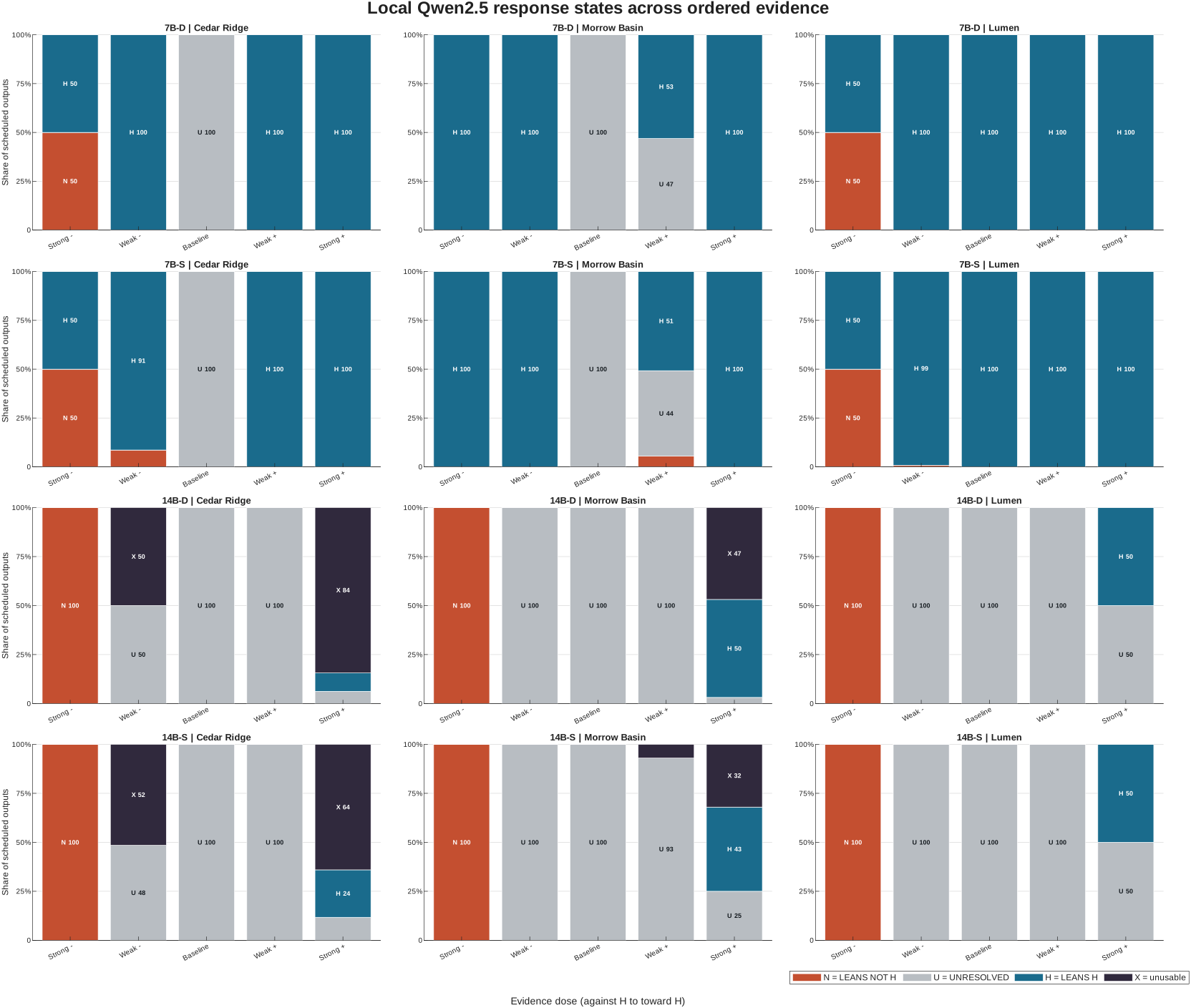
What ran
The campaign used Alibaba-origin Qwen2.5 open-weight models in 7B and 14B capacity strata, with deterministic and stochastic regimes. The public aggregate records 4,800 scheduled rows, no duplicate attempts, no replacements, no runtime errors, and no truncations.
Evidence dose
Response profiles were collected across the five ordered evidence doses used by the mature instrument. The aggregate conclusion is descriptive: dose behavior was not uniformly monotone.
Nuisance pairs
There were 60 blinded nuisance comparisons across scenarios and local-model strata. Seventeen had a nonzero response-share shift.
Schema accounting
Schema adherence was 94.6667%. Invalid enum outputs remain invalid; they are not repaired into substantive answers.
Surface-cue concordance
2,519 of 4,800 outputs were concordant with a predeclared shallow-cue heuristic. This is a behavior-level observation, not evidence of internal cue use or mechanism.
What this supports
The local campaign shows that real local models can produce observable dose variation, nuisance shifts, and schema-invalid output under the rebuilt instrument. Those observations are useful stress evidence for the evaluation machinery and for the limits of clean interpretation.
What this does not support
- It is not Claude or Gemini evidence and does not substitute for the unexecuted provider study.
- The 7B/14B contrast is not a causal capacity effect.
- Surface-cue concordance does not identify an internal mechanism.
- Qwen2.5 behavior does not establish a claim about Chinese models generally.
- The campaign is not a confirmatory Experiment 3 result.